Journal
We Domesticated Wolves Into Dogs. Now AI Is Doing the Same to Us.?
Jan 23, 2026
Emerging Tech
Short answer: yes — and it starts with convenience.
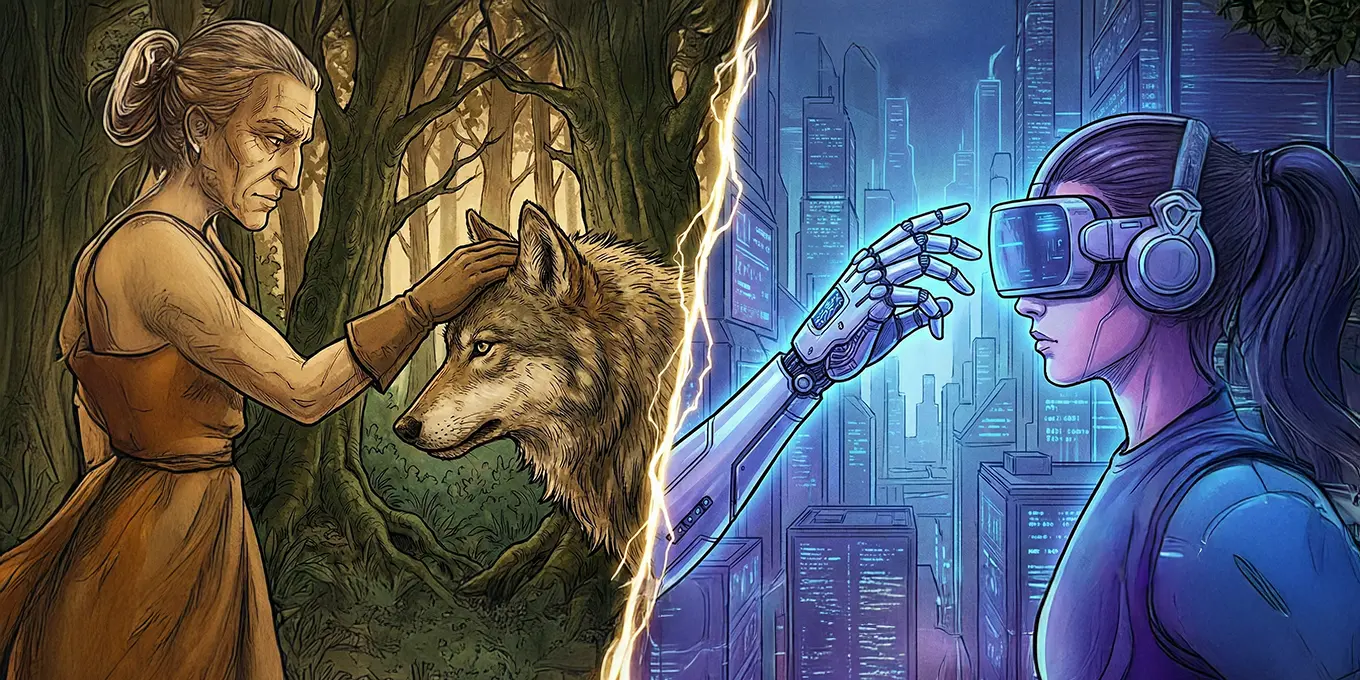
Thousands of years ago, wolves chose humans.
Not because humans were stronger.
Not because humans were smarter.
But because humans were convenient.
The wolves that hung around human camps got food without hunting, warmth without fighting, and protection without constant vigilance. Over generations, the most aggressive and independent wolves did not survive in this environment. The friendlier, more compliant ones did.
That is how wolves became dogs. And that same arc of domestication is unfolding again. This time, it is happening to us.
Why domestication does not look dangerous at first
Domestication does not look like weakness at first
Domestication is not an overnight collapse. It is a slow trade.
You give up a little effort.
You gain a little comfort.
Then you repeat.
Cars replaced walking.
Elevators replaced stairs.
Remote controls replaced standing up.
Food apps replaced cooking.
Each step made sense. Each step felt like progress. But the long-term effect was clear: physical effort slowly became optional.
Now, with AI, we are repeating the same pattern — but at the cognitive level.
How AI shifts us from physical laziness to mental outsourcing
AI did not start by replacing thinking. It started by assisting it.
Spell-check helped us write.
Search engines helped us remember.
Autocorrect helped us type.
Then came recommendation engines.
Then copilots.
Then full-blown idea generators.
Today, many professionals do not start with a blank page anymore. They start with a prompt. And that is where the shift becomes dangerous. Because when thinking becomes optional, judgment erodes.
What this looks like in the real world
What I see when hiring the new generation
I have hired product designers, product managers, and young professionals who are incredibly capable. Fast. Tool-savvy. Confident.
But I have also noticed something new. Many of them struggle to work without AI.
They can generate outputs quickly, but they struggle to:
Explain why an idea is good
Defend a decision under scrutiny
Navigate ambiguity without asking the model first
When I ask, “Why did you choose this approach?”, the answer is often:
“The AI suggested it.”
That is not incompetence. That is dependency forming in real time. Just like dogs learned to look at humans for cues, many professionals are learning to look at AI for validation.
Why this does not mean AI is the enemy
The benefits are real (and undeniable)
Let us be clear. AI is not the villain. AI is incredibly powerful when used correctly.
The pros are obvious:
Speed and scale that humans cannot match
Access to knowledge that was once locked behind expertise
Faster ideation, prototyping, and execution
Reduced friction in everyday work
AI lowers the cost of trying ideas. It democratizes creativity. It helps small teams punch above their weight. This is real progress. But progress without restraint has consequences.
The hidden cost of cognitive domestication
The hidden cost no one talks about
The problem is not AI making us faster. The problem is AI making us passive.
When you stop struggling with a problem, when you stop sitting with uncertainty, when you stop building intuition through failure, you do not just save time. You lose depth.
Over time, this leads to:
Shallow thinking
Homogenized ideas
Reduced originality
Weak decision-making under pressure
If everyone uses the same tools the same way, ideas start to converge. Innovation becomes predictable.
How domestication actually works
This is how domestication actually happens
Dogs did not lose their wild instincts because they were weak. They lost them because they no longer needed them. The environment rewarded compliance, not independence.
AI is creating a similar environment for humans. Why think deeply when the answer appears instantly? Why explore alternatives when the first output looks “good enough”? Why build mental models when prompts seem to work?
Over time, thinking muscles atrophy. And what we gain in convenience, we lose in agency.
The real choice: master or dependent
Becoming the master, not the slave
The solution is not rejecting AI. The solution is changing how we use it.
AI should not replace thinking. It should amplify structured thinking.
That is why I built a prompt library focused not on outputs, but on how innovators think.
Instead of asking AI: “Give me ideas” you ask:
“Break this problem using first principles”
“Apply the Jobs-To-Be-Done framework”
“Invert this problem and show failure paths”
“Stress-test this decision using second-order effects”
“Map incentives before proposing solutions”
These prompts force you to stay involved. They turn AI into a thinking partner, not a crutch.
Why friction still matters
Innovation requires friction
Real innovation has always required:
Cognitive effort
Mental discomfort
Wrestling with uncertainty
Making decisions without perfect information
AI removes friction. That is useful. But innovators must re-introduce the right kind of friction deliberately.
Frameworks. Mental models. Structured reasoning. These are what keep you sharp in an age of abundance.
So, is AI domesticating us?
The choice in front of us
Wolves did not know they were being domesticated. We do. That gives us a rare advantage.
AI can either make us:
Faster but softer
Or faster and sharper
The difference is intent. If you build your thinking skills alongside AI, you become its master. If you outsource thinking entirely, you become dependent. The trajectory is already visible. The question is whether we correct it.
A final note
If you are a product designer, product manager, entrepreneur, innovator, professional building in this era, your edge will not come from knowing the latest tool. It will come from how you think when everyone has access to the same tools.
If you want to explore 100+ structured innovation prompts and mental models designed to keep humans in control, you can check out the work at Visit Kellylabs.xyz
Use AI. Enjoy the leverage. Just do not forget how to think without it.
Explore next
Currently Traveling